
Jackson County Court Records After a Jail Arrest
After an arrest in Jackson County, the person is typically booked at the Jackson County Jail, and the jail record may show the arrest date and time, arresting officer, status, bond, warrant number, statute, offense description, offense type, and court. That is not the same record as the court case. The court record begins to matter when the Magistrate Court, Clerk of Courts, Solicitor-General, or District Attorney file or process charges through a court docket.
Use jail inmate records for custody and booking details, including current-inmate and recent-booking searches on the sheriff-linked OffenderIndex roster. Use jail mugshots for the booking-photo rules. Court records after an arrest belong with the Clerk of Courts and the appropriate prosecutor: the Solicitor-General for State Court misdemeanor and traffic matters, and the Piedmont Judicial Circuit District Attorney for Superior Court felony cases.
How to Find Jackson County Court Records After an Arrest
The official court-file route is the Jackson County Clerk of Courts. Clerk Camie W. Thomas's office covers Superior, State, Magistrate, Juvenile, Jury, and BOE records, and the county Clerk page says Superior and State civil and criminal records are searchable online. The case-search portal is the Clerk's Web Case Search through Icon Case Management. Searching is described as free, while printed copies require an account or payment setup.
- Open the Jackson County Clerk Web Case Search.
- Search by defendant name once the case has been filed, or use a case number if one is already known.
- Open the matching case and compare the court charges with the jail roster's booking charges.
- Check each charge for statute, offense level, court, current status, disposition, sentence, and release-related notes if shown.
- For older civil or criminal files, contact the Clerk because the county page notes pre-1998 records may require 24 hours of archived-storage retrieval time.
The Clerk page lists the office at 5000 Jackson Parkway, Suite 150, Jefferson, GA 30549, with county phone 706-387-6246. The Clerk's own site also lists 706-387-6255. Office hours are Monday-Friday, 8 a.m.-5 p.m. Payments listed in the research include cash, money order, cashier's check, and debit or credit cards; card payments carry a 4% convenience or transaction fee.
The manifest screenshot below comes from the official Jackson County Clerk Web Case Search entry, which is the court-record starting point after a jail arrest.

The portal inspection showed Icon Case Management version 5.1.3.1 and a VIEWONLY-style login screen, so users should treat the Clerk site and Clerk counter as the official fallback when online fields are limited.
First Appearance Court Records After an Arrest
Jackson County Magistrate Court says every felony defendant, and many misdemeanor defendants, are brought before a magistrate within 48 hours of arrest for a First Appearance Hearing. The hearing advises the defendant of rights and charges, and bond is usually addressed based on the charge, community ties, and criminal history. Hearings are held Monday-Saturday in a courtroom inside the Jackson County Jail, which explains why court activity can begin before a person leaves the jail facility.
Magistrate Court is also the primary court for arrest and search warrants in Jackson County. A chief or associate magistrate is on call 24/7 to review and sign warrants. If an arrest started with a warrant, the jail record may show a warrant number, but the court record is where warrant, probable-cause, bond, and later filing activity can become part of the case history.
How Charges Get Filed After an Arrest: Complaint, Accusation, and Indictment
Booking charges are the first public charge labels many users see, but they are not always the final court charges. After law enforcement books a person into the jail, a prosecutor reviews the file and can file, amend, reduce, add, or decline charges. In Georgia practice, misdemeanor and traffic cases often proceed by accusation in State Court through the Solicitor-General, while serious felony cases may proceed in Superior Court through a District Attorney accusation, information-style filing where permitted, or grand-jury indictment.
| Document | Filed By | Common Use After Arrest | What to Check |
|---|---|---|---|
| Warrant or complaint | Officer, applicant, or court process | Initial probable-cause and arrest basis, especially through Magistrate Court | Warrant number, alleged offense, judge action, and first appearance notes |
| Accusation / information-style filing | Solicitor-General or prosecutor | Many misdemeanor, traffic, and some prosecutor-filed criminal cases | Formal count wording, statute, court, filing date, and arraignment status |
| Indictment | Grand jury through the District Attorney | Felony prosecutions in Superior Court | Indicted counts, dismissed booking charges, added counts, and case number |
DA and Solicitor Routing for Court Records After Arrest
The Jackson County Solicitor-General prosecutes misdemeanor offenses and traffic violations in State Court. The office reviews cases from local law enforcement, investigates further when needed, files formal charges, and prosecutes in State Court. The current Solicitor-General listed in the research is Gabriel Bradford at 5000 Jackson Parkway, Suite 260, Jefferson, GA 30549, phone 706-387-6331.
The Piedmont Judicial Circuit District Attorney prosecutes Superior Court criminal cases and appeals for Barrow, Jackson, and Banks counties. The Jackson County DA page lists Brad Smith as District Attorney at 5000 Jackson Parkway, Suite 160, Jefferson, GA 30549, phone 706-387-6288, with hours Monday-Friday, 8 a.m.-5 p.m. Prosecutors file and manage charges, but the Clerk remains the record custodian for filed case documents.
The official Solicitor-General page identifies the office responsible for State Court misdemeanor and traffic prosecutions after many Jackson County arrests.
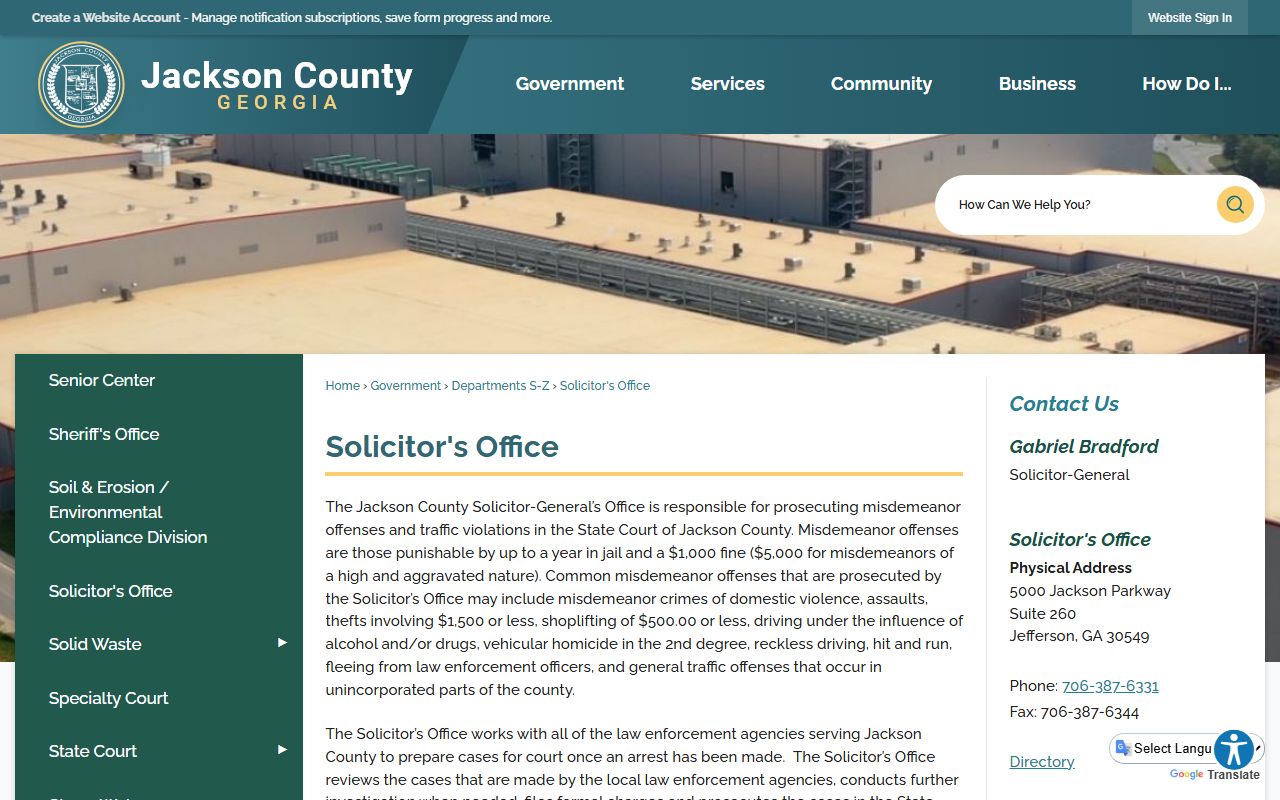
That routing matters because a jail roster charge that looks severe at booking may be reduced, amended, or handled as a misdemeanor after prosecutor review.
Charge Status and What It Means
Charge status is the part of the court record that tells users what happened after the arrest. A jail roster may show the charge description that existed at booking, while the Clerk case record may show a different filed charge or a different result. Always compare the roster's statute, offense type, court, and warrant number with the Clerk case entry.
| Status | What It Means | Why It Can Differ From the Jail Roster |
|---|---|---|
| Pending | The charge has been filed or is awaiting court action. | The person may still be in jail, bonded out, or later transferred while the case remains open. |
| Amended / reduced | The prosecutor changed the charge wording, level, statute, or count. | Booking charges can be broad or preliminary before formal review. |
| Dismissed | The court dismissed the charge or count. | The booking event may remain in jail or criminal-history records unless separately restricted. |
| Nolle prosequi | The prosecutor chose not to proceed on that charge. | A charge can stop even though the arrest and booking record still existed. |
| Convicted / pled | A guilty plea or verdict created a conviction and sentence. | The case has moved beyond accusation into final court disposition. |
Bond and Release After an Arrest
The sheriff's bonding page lists three local paths: cash bond, property bond, and professional bondsman. A cash bond must be posted for the full amount, and Jackson County accepts money orders or certified checks from a local bank. A property bond requires Jackson County property valued at twice the bond amount. Professional bonding companies usually charge 10% to 12% as a nonrefundable fee, and the sheriff says the office will not recommend one company over another.
| Bond Type | Jackson County Detail |
|---|---|
| Cash bond | Full bond amount by money order or certified check from a local bank; returned at the end of the criminal trial or plea if conditions are met. |
| Property bond | Jackson County property owner uses a deed or current tax statement; property must be worth twice the bond amount. |
| Professional bondsman | Approved company signs the bond for a usual 10% to 12% fee; the fee is nonrefundable. |
| No-bond or hold | Bond may be unavailable, not yet set, revoked, or blocked by another jurisdiction, DOC, parole/probation, federal agency, or ICE detainer. |
Magistrate bond conditions can include no alcohol, no firearms, no drugs unless prescribed, no new law violations, and no victim contact in violence cases. Violating bond conditions can lead to revocation and remand to jail even if the person originally bonded out.
Warrants That Lead to an Arrest
The sheriff's Warrants Division page points users to Jackson County's Most Wanted page and uses the general sheriff contact at 555 Stan Evans Drive, Jefferson, GA 30549, phone 706-367-8718. The Most Wanted page is a static list with names, photos, and wanted-for text, not a full searchable warrant database. It tells users to call the Sheriff's Office or the Anonymous Tip Line at 706-367-3784 and not to try to apprehend a listed person.
For citizen warrant applications, Magistrate Court requires facts sufficient for a judge and instructs applicants to report the issue to the appropriate law-enforcement agency and obtain an incident report before the warrant application is accepted. False statements may create criminal and civil liability. If a warrant results in a booking, the roster may show a warrant number, while the court record explains what happened next.
Charges vs. Convictions in Court Records After Arrest
An arrest and charge are accusations, not proof that the person committed the offense. The court record should be read for the actual disposition, not just the booking charge. A charge can be pending, dismissed, amended, reduced, or resolved by plea or verdict.
| Charge | Conviction | |
|---|---|---|
| Stage | Accusation after arrest or prosecutor filing | Final result after plea, verdict, or adjudication |
| Record source | Jail roster, warrant, complaint, accusation, indictment, or Clerk case entry | Clerk disposition, sentence, and criminal-history reporting |
| Legal meaning | Allegation that still must be proven or resolved | Court finding or plea that can carry sentence and collateral consequences |
| Can change? | Yes, charges may be added, reduced, amended, dismissed, or declined | Changes usually require later court order, appeal, modification, restriction, or pardon-related process |
Sealed vs. Expunged Arrest Records
Georgia commonly uses the term record restriction rather than expungement. Georgia.gov explains that eligible records may be hidden or restricted from public view instead of literally destroyed in many cases. GBI record restriction under O.C.G.A. 35-3-37 is a criminal-history process and does not automatically rewrite every court index, news article, or commercial page.
| Restricted / Sealed | Expunged | |
|---|---|---|
| Georgia usage | Common public-facing result for eligible arrest or criminal-history records. | Often used casually by the public, but Georgia sources emphasize restriction from public access. |
| Visibility | Limited from non-criminal-justice public access when approved. | Do not assume destruction unless a specific law or order says so. |
| Law enforcement access | Criminal-justice agencies may retain access under Georgia rules. | Very case-specific; verify the exact order and agency record. |
| Where to start | Georgia.gov and GBI record-restriction information, plus the Clerk for court-file questions. | Ask the court or a Georgia attorney if a disposition qualifies for broader relief. |
Background Check Considerations
Casual public-record searches are different from employment, tenant, credit, insurance, and other regulated background checks. Court records after a jail arrest can be incomplete if the case is new, sealed, restricted, still pending, or not yet visible in the online portal. For any high-stakes decision, use a legally compliant process and verify directly with the Clerk or originating agency.
Important: This website is not a consumer reporting agency under the FCRA and cannot be used for employment, tenant, credit, insurance, or similar screening.
Restricted Court Records After an Arrest in Jackson County
Some records are not fully public. Juvenile matters, sealed charges, restricted criminal-history records, adoption records, ongoing investigations, protected victim information, and redacted sheriff records may be limited by law or court order. Georgia's Open Records Act is the fallback for public agency records when a roster or portal does not show the item, but the three-business-day response rule is a response and access framework, not a promise that every record will be produced immediately.
Use the sheriff's open-records process for jail, booking, and incident records that are not visible on the roster. Use the Clerk of Courts for filed court documents. Use Georgia record-restriction resources for eligible arrest-history restriction. Those routes overlap, but each office controls a different record set.